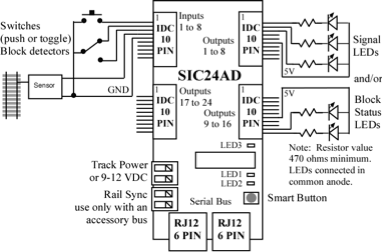
SIC24AD - Signal & Indicator Controller
Discontinued
The SIC24AD (Signal and Indicator Controller) is uniquely suited to control various types of signals and indicators on a layout or a CTC panel. It can be used as a signal controller, to indicate block occupancy and turnout position, and as a grade crossing gate controller with flashing signals. It can be used as a general input/output unit to work with PC software like JMRI. Combinations of some of these features are also possible. The SIC24AD is compatible with many DCC systems* (see below).
MSRP - 54.95 USD
Manual in PDF format
Features:
Control signals on your layout
• Built-in logic for automatically controlling signals using block detection
• Configurable to model many signaling systems
• Computer not required, but can be used with one
Control indicators on your layout or CTC panel
• Block detection
• Turnout status
• Crossing gate and flashers
Provides 24 outputs
• Drives up to eight 3 LED signal heads with common anode or common cathode
• Drives Bi-color LED searchlights with 2 or 3 leads.
• Drives Tortoise™ switch machines for turnout control
• Drives Tortoise™ switch machines for semaphore signal control including the middle yellow aspect.
Provides 8 inputs
• For local turnout control.
• For occupancy sensors
• For turnout feedback sensors
Simple inter-board wiring
• Serial bus reduces system wiring
• Digitrax LocoNet® compatible
• DCC gateway to serial bus
Simple basic setup
• Built-in setup configuration options
• "Smart Programming" in conjunction with self programming
Features differences from old SIC24:
• "Smart Programming" has been greatly improved with additional options for easier setup.
• CVs 1 to 9 have changed to be similar to SRC16.
• Decoder Configuration CV9 has some different options. No option to support Digitrax SE8C.
• Digitrax specific - improved LocoNet® interface resulting in fewer grounding issues with LocoNet®.
• DCC to serial bus gateway option.
• Optionally can be powered from the track (HO scale or smaller).
Operation:
The SIC24AD has 24 outputs. Each output can drive an LED and can be assigned a specific function. For signal control, a three color aspect signal will require three outputs if each aspect is to be individually controlled. For example a single SIC24 can control eight signal masts with three aspects each.
Typical signal control is based on some set of rules or logic to turn each LED on. Consequently, some logic is required to turn on and off each output. In order to accomplish this, the SIC24AD has a logic cell that controls each output. The logic is programmable using CVs. So you can control almost any kind of signals There are several build in selectable setups so that individual CV programming may not be necessary. These include block signals, block signals with a siding, block occupancy indication, grade crossing, block searchlight signals and general purpose input/output.
The SIC24AD has eight inputs. Each input can be used for block information, switch state, push buttons etc. Unique signal schemes can be implemented by connecting outputs to inputs.
If more than one SIC24AD is used in a signal system the serial bus is used to pass information between SIC24ADs. Since communication is done over a serial bus, the number of wires to implement a signal system is greatly reduced. The SIC24AD is compatible with LocoNet® block detectors such as the Digitrax BDL16 or detectors connected to its inputs such as the Team Digital DBD22 .
Typical the SIC24AD uses information via it's inputs or via the serial bus to determine the signal state. However, by enabling the DCC gateway the SIC24AD can also receive switch state information from the track DCC. This is very similar to an accessory (stationary) decoder.
Programming:
The SIC24AD can be very challenging to program because of it's logic capability. To assist in programming, there are several built-in setup options. The setups are implemented using "Smart Programming" in conjunction with self programming. By entering several switch commands from the throttle, one of the setups is selected and configured. Once selected, the logic is automatically determined and all the required CVs programmed. The SIC24AD comes pre-programmed for block signaling (ABS) of three aspects per signal which is one of the setups. "Smart Programming" is done via DCC turnout (switch) commands.
Programming in page mode can be done using the programming track or "On the Main" Operations (Ops) mode programming.
Compatibility:
The SIC24AD is not fully compatible with the Atlas, Backmann or MRC (except Prodigy Advance) DCC systems because they do not support accessory commands or can not program the number of CVs in the SIC24AD.