
Resistive Wheel Sets
Adding Resistors to Metal Wheel Sets
One way to add resistance to a freight car with Jay-Bee metal wheels, is to "hang" a 1/4-watt resistor between the two axles as shown below.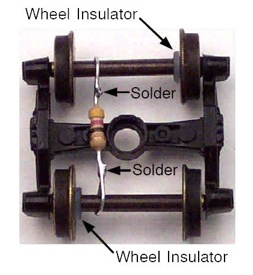 This illustration shows the bottom side of the truck.
This requires the two axles to be installed in opposite directions from each other, with one insulated wheel on the right rail, and the other on the left rail - pointed out above. With the resistor running between the two axles as shown, power will travel from the non-insulated wheel on one rail through the resistor to the non-insulated wheel on the other rail.
Wrap the resistor leads loosely around the axles until they overlap themselves, solder the lead to itself, then snip the excess resistor lead off - also shown above. When properly done, there will be no binding of the resistor to the axles. A drop of Conducta Lube or Automatic Transmission Fluid (ATF) on each axle will assure they run smoothly, get clean, and stay clean for adequate contact.
While "hanging" resistors on axles is a very cost-effective way of getting freight car detection, you can also purchase Jay-Bee wheel sets with resistors already in them. This costs a little more, but is a whole lot faster and easier.
Current-sensing block detectors generally require a certain amount of current to be drawn in order to trigger the detector. This is where the resistance requirement comes in. The higher the resistance, the less current is being drawn. Ultimately, with DCC, you want to draw the least amount of current possible and still have your block detectors work reliably.
Team Digital note: When our DBD22 detector is powered with 5 volts the typical trigger (track) current is 3 ma. When powered with 12 volts it is 6 ma. So with a HO track voltage of 14 volts, a resistance of 4700 ohms (14 / 4700 ~ 2.97 ma) will trigger the block detector when powered by 5 volt. Our BlocD8 has an adjustable trigger current. In both products the sensitivity can be increased by looping the feed wire through the black current sensor two times. Increased sensitivity means less current required for detection.