Switch Machines
The purpose of a switch (turnout) machine is to move the switch (points) to a different position so that a train's route is changed. There are several types of machines. Below are pictures of some common switch (turnout) machines. A switch (turnout) machine is an electromechanical device that moves a lever or arm when a voltage is applied. Each type has advantages which includes size, ease of installation, type of control and cost.
Solenoid or twin coil - A momentary voltage causes a lever to moves to 1 of 2 positions.
Stall motor - A constant voltage causes a lever to moves to 1 of 2 positions*
Servo - A stream of voltage pulses causes a lever to moves to many different positions.
* Note: The meaning of "stall motor" used to be synonymous with Tortoise™ which has a very low current draw. However, more motors are being called "stall". For example the Cobalt is being called a stall motor yet requires ~ twice as much current as a Tortoise™. This does not necessarily make the Cobalt a bad motor. It means before you purchase an accessory decoder find out what kinds of "stall motors" it can drive. Note: 1/22/15 the Cobalt iP Analog has a much lower current requirement.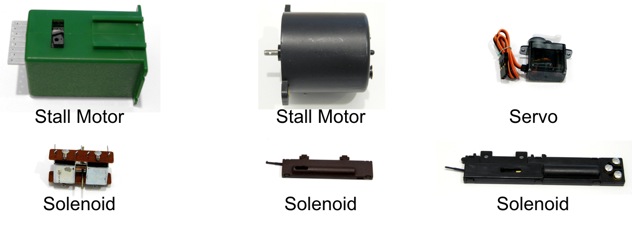
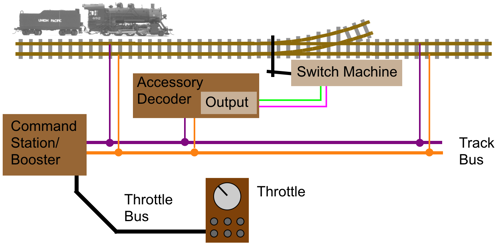
To remotely control a switch machine in a DCC system an electronic device called an accessory decoder is required. Accessory decoders receive commands (instructions) via DCC commands that are present on the track just like a loco decoder. Wherever the throttle is located, accessory control is available. Some throttles and DCC systems do not provide for turnout control.
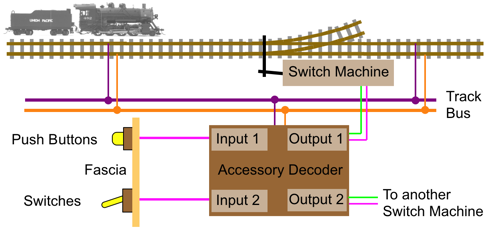
Some accessory decodes provide for controlling switch machines via push buttons or electrical switches. These are typically used for local (close or near) control of a turnout or perhaps from a panel. Team Digital has a number of accessory decoders to choose from. See products for a comparison.