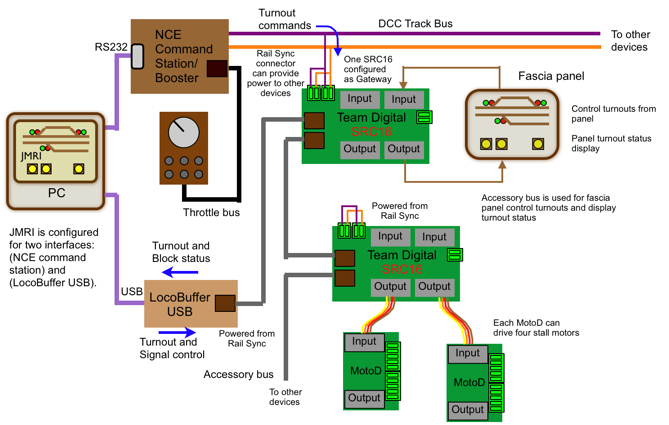
Turnout control from a Throttle, CTC panel and Fascia panel
General Operation:
This scheme provides for turnout control from a dispatcher using a Centralized Traffic Control (CTC) panel with Team Digital SRC162(s) and MotoD(s) in a DCC system. Turnout control is also available via a throttle. It also demonstrates the concept of an accessory bus.
An accessory bus also called serial bus is defined as an independent serial bus separate from the throttle bus. This can provide several advantages for a DCC system. One of the big advantages of an accessory bus is that it provides a "two way street" for accessories to communicate with each other. With regard to accessories DCC is a "one way street". That is, control information is sent from the command station in the form of DCC packets on the track bus. Accessories monitor this information and respond to instructions with their address. There is no provision for accessories to "talk back" to the command station via DCC. Also, an accessory bus can expand the selection of devices available for applications and can aid in trouble shooting.
The SRC162 is an accessory decoder and can be powered from DCC track power. Since it can be controlled via DCC commands it's gateway feature provides a very convenient way to pass turnout (switch) commands to the accessory bus. This allows DCC turnout commands to control devices connected to the accessory bus. Thus, turnouts can be controlled either from the throttle, the dispatcher and local panel. Later versions of the SRC162 provide local control lockout so the dispatch can have complete control.
Turnouts:
SRC162(s) are used to control turnouts and optionally indicate turnout status. They can drive stall motor type switch machine with 5 volts or with a higher voltage using MotoDs. With MotoDs the SRC162 2control up to 16 stall motors.
Fascia Panel:
A fascia panel can contain push buttons for local control of turnouts. Optionally it could have LED indictors for turnout status. A SRC162 make a very convenient interface as it can be used to issue turnout commands and update status indicators.
CTC Panel:
The CTC panel is depicted on a computer screen using software like JMRI. It allows the dispatcher to control turnouts and the display of layout status via the accessory bus.
JMRI is capable of having more than one interface. In this case the computer is shown connected to the NCE command station via RS232 and connected to the accessory bus via a USB cable and a LocoBuffer USB. JMRI must be configured for a NCE interface and LocoNet® interface since the accessory bus is compatible with Digitrax's LocoNet® .
Power:
The SRC162(s) may be powered from a dedicated power supply or the track. Using the rail sync lines in a separate accessory bus provides easy power connections for multiple devices. The Locobuffer can also be powered from rail sync
Note: SRC16 is sometimes used to refer to the original SRC16, the SRC162 and SRC16e.
NCE DCC system with dispatcher control