Turnout and Signal control with a separate Accessory bus
General Operation:
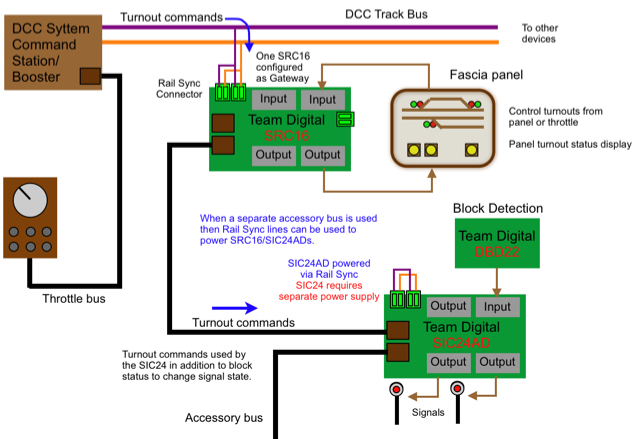
This scheme provides for turnout and signal control using a Team Digital SRC162(s), SIC24e(s) and DBD22(s) in a DCC system. It also demonstrates the concept of an accessory bus.
An accessory bus is defined as an independent serial bus separate from the throttle bus. It provides a way for accessory devices to communicate with each other. This can provide several advantages for a DCC system.
In a Digitrax system an accessory bus can be used to keep accessory communication traffic off the main throttle bus. This can provide fewer throttle control issues when multiple throttle are in use. In other DCC systems, such as NCE, an accessory bus can expand the selection of devices available for applications. Also trouble shooting is made easier.
The SRC162 is an accessory decoder and can be powered from DCC track power. Since it can be controlled via DCC commands it's gateway feature provides a very convenient way to pass turnout (switch) commands to the accessory bus. This allows DCC turnout commands to control devices connected to the accessory bus. Thus, turnouts can be controlled either from the throttle or from fascia buttons.
Turnouts:
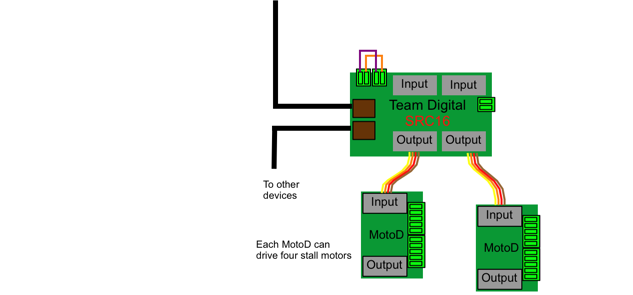
SRC162(s) are used to control turnouts and indicate turnout status. They can drive stall motor type switch machine with 5 volts or with a higher voltage using MotoDs.
Block Status:
DBD22(s) are connected to the SIC24e(s) to provide block status.
The SIC24e(s) use the block status information in the signal logic.
Signaling:
SIC24e(s) are used to drive the signal aspects. The specific aspect to light is determined by the SIC24e logic. The logic uses block status information and turnout state to determine the signal state. When multiple SIC24es are used internal logic information of the SIC24es are passed over the serial bus to each other.
The serial bus greatly simplifies wiring because the SIC24es can be located around the layout near the signal aspects they are driving. This means the DBD22s will be near the blocks they are detecting.
Power:
The SRC162(s)/SIC24e(s) may be powered from a dedicated power supply or the track. Using the Rail Sync (RS) lines in a separate accessory bus provides easy power connections. In a Digitrax system Rail Sync is a replica of the track power signal but has limited power. One of its uses is to provide power to throttles connected to LocoNet. In the SRC16 2 the RS is only connected to the two terminal RS connector. In the system depicted here where the SRC162 is NOT connected to LocoNet the RS may be used to pass power from one SRC16 to another. When a large number of devices are used a separate power bus is recommended. DBD22(s) are powered from the SIC24e(s).
Note: SIC24 is sometimes used to refer to the original SIC24, the SIC24AD and SIC24e. The original SIC24 can NOT be powered from the track.
DCC system with a separate Accessory bus