SRC16 - Switch & Route Controller
Discontinued
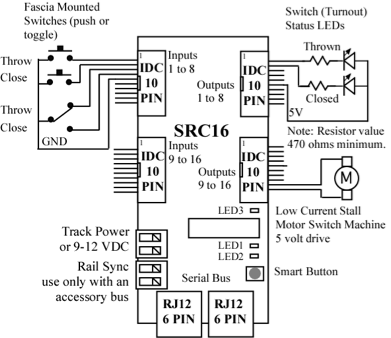
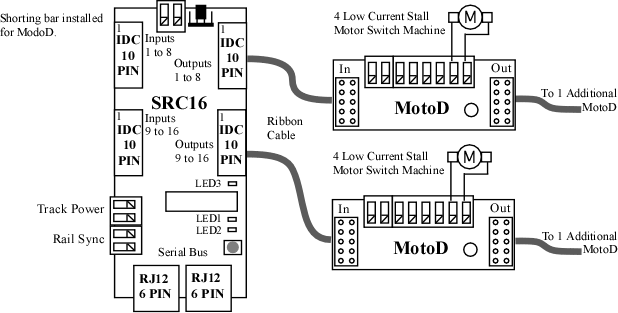
The SRC16 is a DCC accessory decoder that has 16 inputs and 16 outputs. The standard input configuration is for connecting of eight (8) pair of push buttons for switch (turnout) control. The standard output configuration is for connecting eight (8) pair of LEDs for switch (turnout) status indication or eight (8) Tortoise™ switch machines. With the addition of Team Digital MotoDs it can control up to 16 Tortoise™ switch machines.
MSRP - 56.95 USD
MotoD and Cable Connector Kit sold separately.
Manual in PDF format
See a "Tech Talk" with the SRC16 used for panel and turnout control.
Features:
Works with any DCC system that supports accessory decoders
Control routes on your layout
• Eight routes
Control indicators on your layout or CTC panel
• Block detection
• Turnout status
• Flashing indicators
Provides 16 outputs
• Drives up to 16 LEDs
• Drives Tortoise™ switch machines for turnout control
• Control up to 16 Tortoise™ switch machines using MotoDs
• Adjustable output voltage using MotoDs
• Output lockout - input prohibits output change
Provides 16 inputs
• For local turnout control.
• For occupancy sensors
• For turnout feedback sensors
Simple inter-board wiring
• Serial bus reduces system wiring
• Digitrax LocoNet® compatible
• DCC gateway to serial bus
Simple basic setup
• "Smart Programming" in conjunction with self programming
Operation:
The SRC16 has 16 inputs and outputs which can each have a unique address. By assigning the same address to a pair of inputs and outputs, called a group (classic SRC mode), the SRC16 can control eight turnouts (switches) or display the state (closed or thrown) of eight turnouts. Activating an input (close or throw) sends a turnout command (messages) that correspond to it’s address over the serial bus. Any device connected to the bus can receive the command. The SRC16 monitors the bus for commands from all sources, including those from itself (sent by inputs). The SRC16 does not require a serial bus connection to operate. When the SRC16 receives a turnout command with an address that matches a group’s address, that output (closed or thrown) is activated. LEDs or stall motors can be connected to the outputs.
Since the SRC16 is a accessory decoder, it can be controlled via DCC commands. It can also be controlled via the serial bus (LocoNet® compatible). A DCC gateway feature allows DCC switch or accessory commands to be passed directly to the serial bus. This allows DCC switch commands to control devices connected to this serial bus. Other devices (SRC16s or SIC24s for example) connected to this “accessory” serial bus can communicate with each other. This can provide several advantages for a DCC system.
Configuration Variables (CVs):
The SRC16 supports Paged Mode Programming in Service Mode and Operations Mode (Programming on the Main).
Smart Programming:
“Smart” programming is a term used to describe an easy way to program Configuration Variables (CVs). The throttle is used to issue switch or accessory commands just like controlling switches (turnouts).
Compatibility:
The SRC16 is not fully compatible with the Atlas, Backmann or MRC (except Prodigy Advance) DCC systems because they do not support accessory commands or can not program the number of CVs in the SRC16.